


Head Restraints
* Some models.
Head restraints are intended to help protect you and the passengers from neck injury.
WARNING:
Always drive with the head restraints
installed when seats are being used
and make sure they are properly
adjusted:
Driving with the head restraints
adjusted too low or removed is
dangerous. With no support behind
your head, your neck could be
seriously injured in a collision.
Height adjustment
To raise a head restraint, pull it up to the desired position.
To lower the head restraint, press the stopcatch release, then push the head restraint down.
Adjust the head restraint so that the top is even with the top of the passenger's ears, never the passenger's neck to prevent injury.
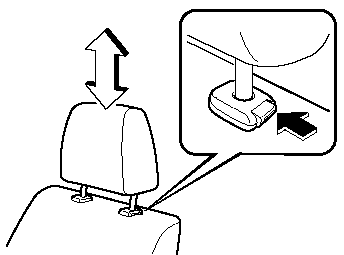
Front seat
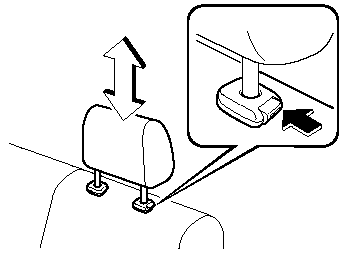
Rear seat
Removal/Installation
To remove the head restraint, pull it up while pressing the stop-catch.
To install the head restraint, press the uprights into the holes while pressing the stop-catch.
WARNING:
Always drive with the head restraints
set up when seats are being used and
make sure they are properly set up:
Driving with the head restraints not
set up is dangerous. With no support
behind your head, your neck could be
seriously injured in a collision.
See also:
Inside Trunk Release Lever (4 Door)
Your vehicle is equipped with an inside
trunk release handle that provides a means
of escape for children and adults in the
event they become locked inside the
trunk.
No matter how careful adults ...
Customer Assistance (Mexico)
Your complete and permanent satisfaction is our business. We are here to
serve you. All
Authorized Mazda Dealers have the knowledge and the tools to keep your Mazda
vehicle
in top condition.
If ...
Fuses
Your vehicle's electrical system is
protected by fuses.
If any lights, accessories, or controls don't
work, inspect the appropriate circuit
protector. If a fuse has blown, the inside
element will ...