


Manual Transmission Operation
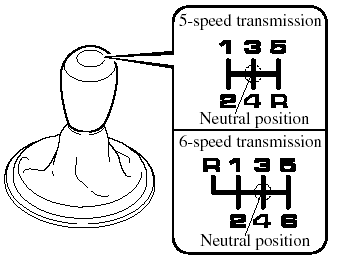
Manual Transmission Shift Pattern
The vehicle is equipped with either a 5- speed or 6-speed manual transmission.
The shift pattern for each is shown above.
Depress the clutch pedal all the way down while shifting; then release it slowly.
(5-speed transmission).
A safety feature prevents accidental shifting from 5 to R (reverse). The shift lever must be put in neutral before being shifted to R.
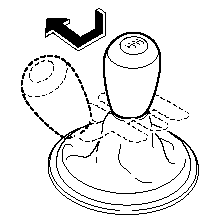
(6-speed transmission).
Vehicles with 6-speed transmission are equipped with a device to prevent shifting to R (reverse) by mistake. Push the shift lever downward and shift to R.
WARNING:
Do not use sudden engine braking on
slippery road surfaces or at high
speeds:
Shifting down while driving on wet,
snowy, or frozen roads, or while
driving at high speeds causes sudden
engine braking, which is dangerous.
The sudden change in tire speed could cause the tires to skid. This could lead to loss of vehicle control and an accident.
Be sure to leave the shift lever in 1 or R position and set the parking brake when leaving the vehicle unattended: Otherwise the vehicle could move and cause an accident.
CAUTION:
 Keep your foot off the clutch pedal
except when shifting gears. Also,
do not use the clutch to hold the
vehicle on an upgrade. Riding the
clutch will cause needless clutch
wear and damage.
Do not apply any excessive lateral
force to the gear lever when
changing from 5th to 4th gear.
This could lead to the accidental
selection of 2nd gear, which can
result in damage to the
transmission.
Make sure the vehicle comes to a
complete stop before shifting to R.
Shifting to R while the vehicle is still moving may damage the transmission.
NOTE:
If shifting to R is difficult, shift back into
neutral, release the clutch pedal, and try
again.
Recommendations for Shifting
Upshifting
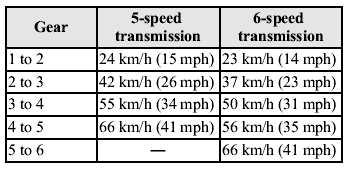
For normal acceleration, we recommend these shift points.
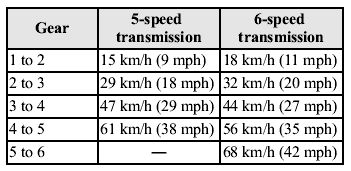
For cruising
Downshifting
When you must slow down in heavy traffic or on a steep upgrade, downshift before the engine starts to overwork. This reduces the chance of stalling and gives better acceleration when you need more speed.
On a steep downgrade, downshifting helps maintain safe speed and prolongs brake life.
See also:
Mazda2 2009 review
The 2011 Mazda2 may very well be the cutest car I've driven to date. Despite
its more than adorable look, the Mazda2 and I took a few days to get to know
each other. Upon my first drive, I have to ...
Supplemental Restraint System Components
1 Driver/Passenger dual stage inflators and air bags.
2 Crash sensor, and diagnostic module (SAS unit).
3 Seat belt pretensioner and load limiting systems.
4 Front air bag sensor.
5 Side crash s ...
Trailer Towing
The Mazda MX-5 is not designed for
towing. Never tow a trailer with your
Mazda MX-5. ...