


Flat Tire
Either run-flat tires or conventional tires are equipped on your Mazda depending on the specification, therefore the procedure for repairing a flat tire differs depending on the type of tire. Before driving, make sure which type of tire is equipped on your Mazda. If you cannot identify your tire type, consult an Authorized Mazda Dealer.
How to identify your tire type
Run-flat tire
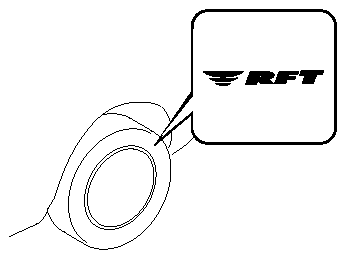
A run-flat tire has a “RFT” mark on the side wall.
Conventional tire
A conventional tire does not have a “RFT” mark on the side wall.
Vehicle with run-flat tires
WARNING:
Have the tires checked or perform the
appropriate repair as soon as possible
by an Authorized Mazda Dealer:
When the flat tire warning light
illuminates or the tire pressure
warning beep sound is heard, it is
dangerous to drive the vehicle at high
speeds, or perform sudden
maneuvering or braking. Vehicle
drivability could worsen and result in
an accident.
When the flat tire warning light illuminates or the tire pressure warning beep sound is heard, decrease vehicle speed immediately and avoid sudden maneuvering and braking.

If a run-flat tire is punctured, the FLAT TIRE warning light illuminates in the instrument cluster, and a beep sound is heard for about 30 seconds.
NOTE:
Until the flat tire is changed, the beep sound is
heard for about 30 seconds every time the
ignition switch is turned to the ON position.
Vehicles with run-flat tires can be driven even with a punctured tire under the following conditions.
Maximum vehicle speed with a punctured run-flat tire: 90 km/h (55 mph).
Maximum driving distance with a punctured rum-flat tire: 80 km (49 miles)
CAUTION:
The maximum driving distance may
be shorter depending on the driving
conditions.
If a run-flat tire is punctured, carefully drive the vehicle to the nearest Mazda Dealer and have the tire changed.
NOTE:
- A spare tire or Instant Mobility System
(IMS) emergency flat tire repair kit is not
equipped on vehicles with run-flat tires as
standard.
- Replacing a punctured run-flat tire with a new run-flat tire is recommended.
- Do not use run-flat tires and conventional tires on the same vehicle.
Vehicle with conventional tires
If the following occurs while driving, it could indicate a flat tire.
- Steering becomes difficult.
- The vehicle begins to vibrate excessively.
- The vehicle pulls in one direction. If a conventional tire is punctured, refer to “Tool Storage” and “Instant Mobility System (IMS) Emergency Flat Tire Repair Kit”.
See also:
Type Approval of Equipment
Immobilizer system
Keyless entry system ...
Mazda5 2008 Review
The Mazda5 minivan is fun to drive. That's right: A minivan that's fun to
drive. How can this be? The secret's in its size, as the six-person Mazda5 is
significantly smaller than traditional miniv ...
Head Restraints
* Some models.
Head restraints are intended to help
protect you and the passengers from neck
injury.
WARNING:
Always drive with the head restraints
installed when seats are being used
and make ...